Which generator to choose for a business or a private home: a guide for winter 2026
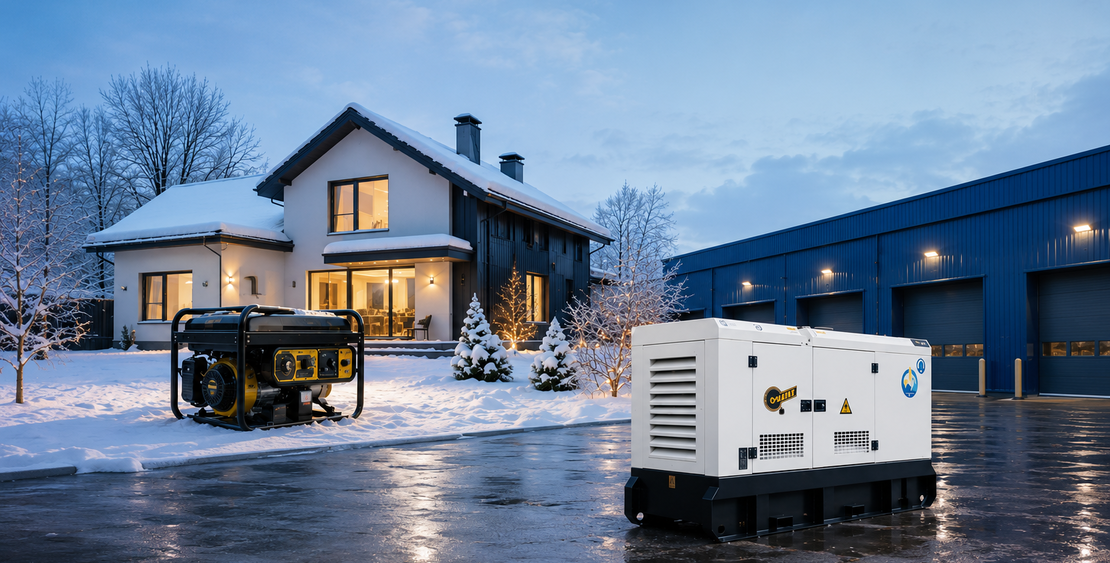
Winter 2026 once again raises the same question for Ukrainians: how to ensure a reliable power supply when outage schedules remain unpredictable. However, the right solution for a private home differs significantly from that for a business—in terms of power output, equipment type, and budget. In this guide, we'll explain how to choose the right generator for each scenario and what to consider before making a purchase.
Generators for Personal Use: What You Should Know
Main selection criteria for an apartment:
- Noise level. A conventional gasoline generator operating on a balcony often leads to conflicts with neighbors and may violate local regulations. For this reason, it is recommended to choose a quiet inverter generator for apartments, with a noise level of approximately 55–65 dB.
- Compact size and lightweight design. Portable generators with an output of 2–3.5 kW are generally sufficient to power a refrigerator, lighting, an internet router, and charge electronic devices.
- Exhaust ventilation. Any internal combustion generator must never be operated indoors. It should only be installed on a well-ventilated balcony or outdoors, with a power cable routed safely into the apartment.
- Alternative solution. If you do not have a balcony or another safe outdoor location, a conventional generator can be replaced with a completely silent portable power station (energy storage system). It charges from the electrical grid, produces no exhaust emissions, and is ideal for apartment use.
If you are planning to purchase a generator for a private house, start with an inverter generator. It provides a stable pure sine wave output, making it safe for sensitive electronic devices and gas boilers equipped with electronic ignition.
Generator for a Private House: How to Make the Right Choice
For a private house, the range of available solutions is much broader, and the selection criteria are different. In this case, extended runtime and higher power output are more important than compact dimensions.
Calculating the required generator capacity for a house begins with making a list of all appliances that need to operate simultaneously:
| Appliance | Approximate Power Consumption |
|---|---|
| Refrigerator | 0.2–0.4 kW |
| LED Lighting | 0.1–0.3 kW |
| Gas Boiler with Circulation Pump | 0.3–0.6 kW |
| Well Pump | 0.5–1.5 kW |
| Router and Device Charging | 0.1 kW |
Be sure to add a 20–30% power reserve to the total calculated load to account for startup current. Appliances with electric motors, such as pumps and refrigerators, typically require 2–3 times more power during startup than during normal operation. For most private homes, this results in a required generator capacity of approximately 5–8 kW.
Additional factors to consider when choosing a generator for your home:
- Fuel type. A diesel generator is more economical for long daily operation, while a gasoline generator is generally more affordable for occasional backup use.
- Automatic Transfer Switch (ATS). This feature is essential if your home contains equipment that cannot remain without power even for a few minutes, such as a heating system during winter.
- Continuous operating time. If your area experiences prolonged power outages, consider models capable of operating for more than 8 hours on a single fuel tank.
Generator for a Business: What Companies Should Consider
For businesses, the cost of downtime caused by a power outage is usually much higher than the cost of a generator itself. That is why the search query "generator for business" is not just informational—it is highly transactional, as companies are looking for a reliable backup power solution as quickly as possible.
Key factors to consider when choosing a generator for a business:
- Load category. Determine whether you need to power the entire facility or only critical equipment such as servers, refrigeration systems, or production lines.
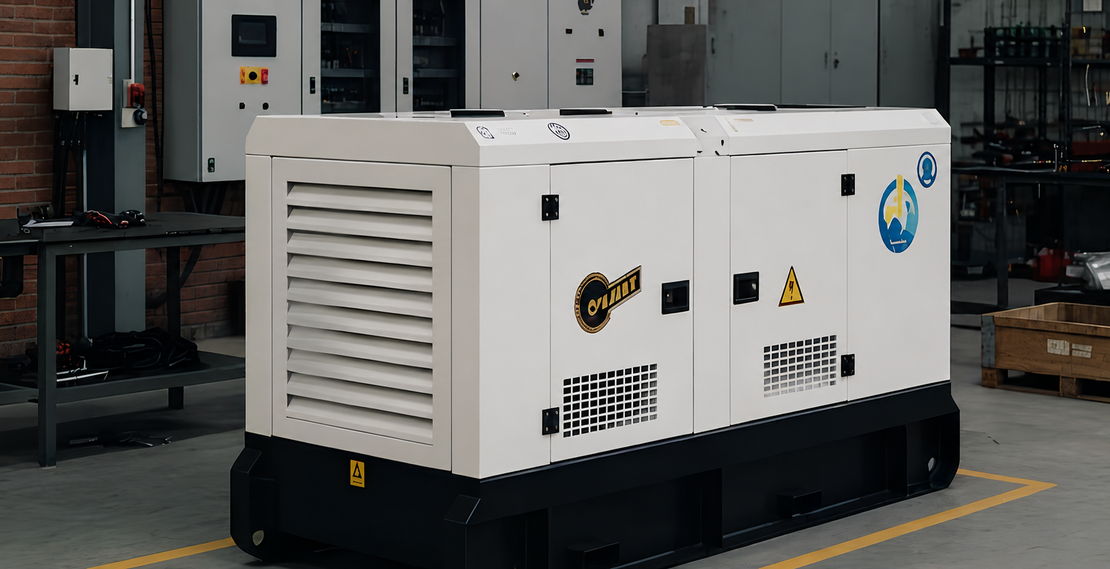
- Generator type. For businesses requiring daily, long-term operation, an industrial diesel generator is the preferred choice. It is more fuel-efficient and durable than gasoline generators, especially for loads above 10 kW.
- Automation and redundancy. Critical facilities such as hospitals, refrigerated warehouses, and data centers should consider systems equipped with an Automatic Transfer Switch (ATS) and, if necessary, a secondary backup generator.
- Service agreement. For commercial operations, downtime caused by generator failure often costs significantly more than the repair itself. Therefore, a professional service contract with guaranteed response times should be considered an essential part of the solution rather than an optional add-on.
A generator for an office or a small manufacturing facility typically starts at 8–10 kW, while warehouses, production plants, and facilities with heavy-duty electrical equipment generally require models rated at 20 kW or higher.
Comparison Table: Which Generator Should You Choose?
| Application | Recommended Power | Generator Type | Key Considerations |
|---|---|---|---|
| Apartment | 2–3.5 kW | Inverter / Quiet Generator | Noise level, ventilation |
| Private House | 5–8 kW | Gasoline / Diesel | ATS, power reserve |
| Country House / Cottage | 2–5 kW | Gasoline | Portability |
| Office | 8–10 kW | Diesel | Stable voltage output |
| Industrial Facility / Manufacturing | 20 kW and above | Industrial Diesel Generator | Service agreement, automation |
Frequently Asked Questions
How many kilowatts does a private house need?
For a typical home with a gas boiler and a water pump, a generator rated at 5–8 kW is usually sufficient, including a 20–30% reserve for startup currents.
What is the difference between an industrial generator and a residential generator?
An industrial generator is designed for continuous operation under heavy loads, offers a significantly longer service life, and is typically diesel-powered, whereas residential generators are intended for occasional backup use.
Can one generator power both my home and a nearby small business?
Technically, yes—provided the combined electrical load does not exceed the generator's rated capacity. However, if the business has critical loads, it is recommended to install a dedicated backup power system with its own professional service support.
Not sure what generator capacity is right for you? Our Smart Grid specialists will calculate your required power free of charge and help you choose the most suitable generator for your apartment, private home, office, or business.